
Why I love to take a break before giving a structured feedback
In short: When you want to give recommendations that really help someone move to the next steps, you sometimes need to take 5 to 10 minutes to prioritize and synthesize to find out what truly matters. Taking a break for this gives me the mental space to do it.

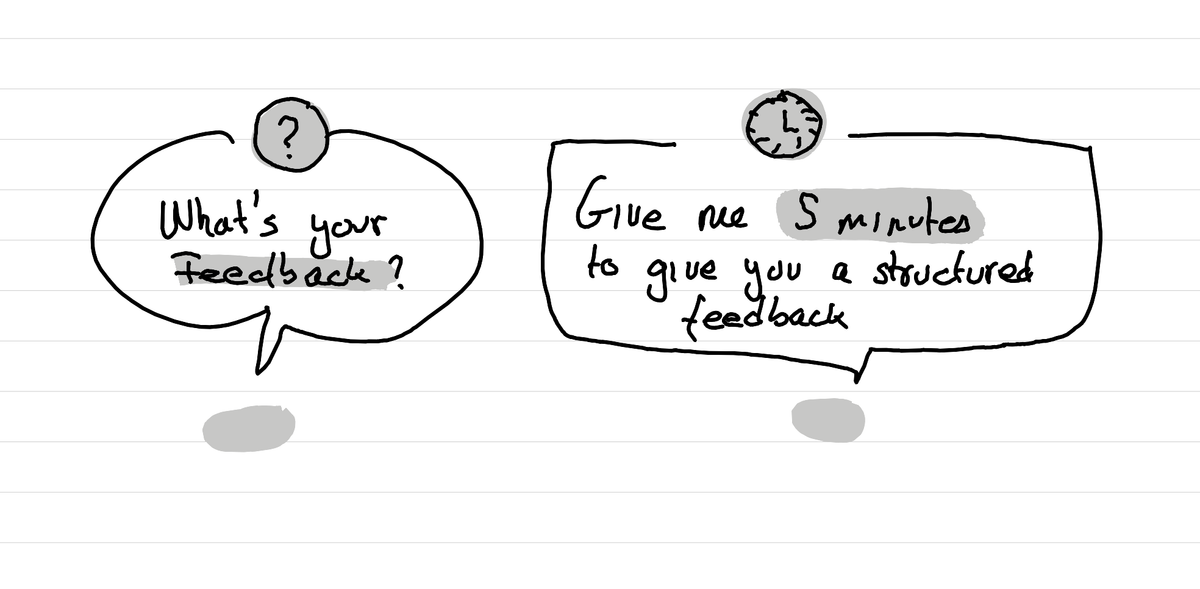
What's great with a break before giving feedback
The break has a few beautiful qualities:
- It gives me time to prepare a quality feedback
- It gives a break to the learner who shared a lot or did a performance
- It shows professionalism as people notice you aren't just reacting, you are really designing the feedback content and moment
Context
I've followed a training on giving effective feedback given by Andreas Cincera. His approach is one based on deep psychological understanding. The goal is to give the feedback in a way that gives a clear direction, without triggering stress or fear so that learning can happen. For that he has a very structured way of giving feedback. Getting into this new approach takes a lot of mental energy, and for now it's hard for me to do that on the spot after a learner has shared something with me, like a preview of their final presentation that will decide if they get or not a Master in Service Design.
The break unlock
So what do you do when you're tasked to give on the spot a feedback, but you need time and energy to make sure the feedback you give is really based on a structure that makes it possible for the person to recieve and hear the feedback?
The unlock is simple. Take a break. Say to the learner or person you are giving a feedback to:
"To give you a structured and synthesized feedback, I'll need a 5 minutes break. I'll come back with key competencies you've showed and with a few recommendations to go further".
During the break I then go over my notes and synthesize them, transform them to fit the structured framework and prioritize them.
Do I always take a break?
No. When the feedback is just about one element, I can do it on the fly, but when the feedback is about a 20 minute presentation, which is really a make or break element (like a jury presentation that defines if a learner gets a degree or not) I prefer at the moment to take that break.
I do it because at the moment, I'm not yet used to this method, so it takes me a bit more time.
But when I reflect about it, I realize that even when I'll be comfortable in doing it on the spot, I might still use a 3 minute break more to signal the seriousness, professionalism and care that I want to give to this feedback moment. So that its clear, this feedback isn't just a gut reaction, it's one that is deeply reflected on.
This article was written on a refurbished Remarkable II tablet with a type folio cover. The illustration was made drawn by hand on the same tablet.If you are curious you can download the original note below.
Related articles
Should feedback be free?
In short: Feedback from co-workers should be free. If it will directly improve something people use, feedback can be free. If it has a more indirect impacted on the person who shares the feedback it should be paid.
What are the mental health challenges a service designer will be faced with?
In short: learn to deal with negative feedback, give enough time for life and learning, keep track of the good stuff, and don't forget to sleep.
How do I separate and combine the coach and jury role?
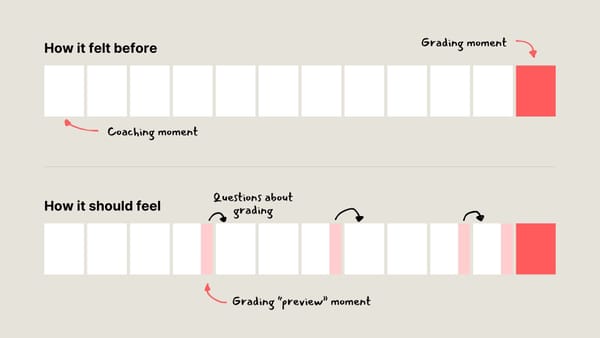
In short: I differentiate the moments where I’m in coach or mentor role versus the moments when I’m in jury or grader role. I also try to bring in more « try out » moments where learners can get a preview of how I see things from my grader role.